What you pay, line by line
There are two bills, and only one of them is ours. Our fee for the statement starts at £655. The council's fee depends on the application the statement goes with: a listed building consent application has no fee at all, while a householder application for an extension pays the national fee of £548 from 1 April 2026, published in the same table.
If your project needs both, as most work to the outside of a listed house does, you file both applications and pay the planning fee once. The statement serves both, so you do not pay for it twice.
Why one statement costs more than another
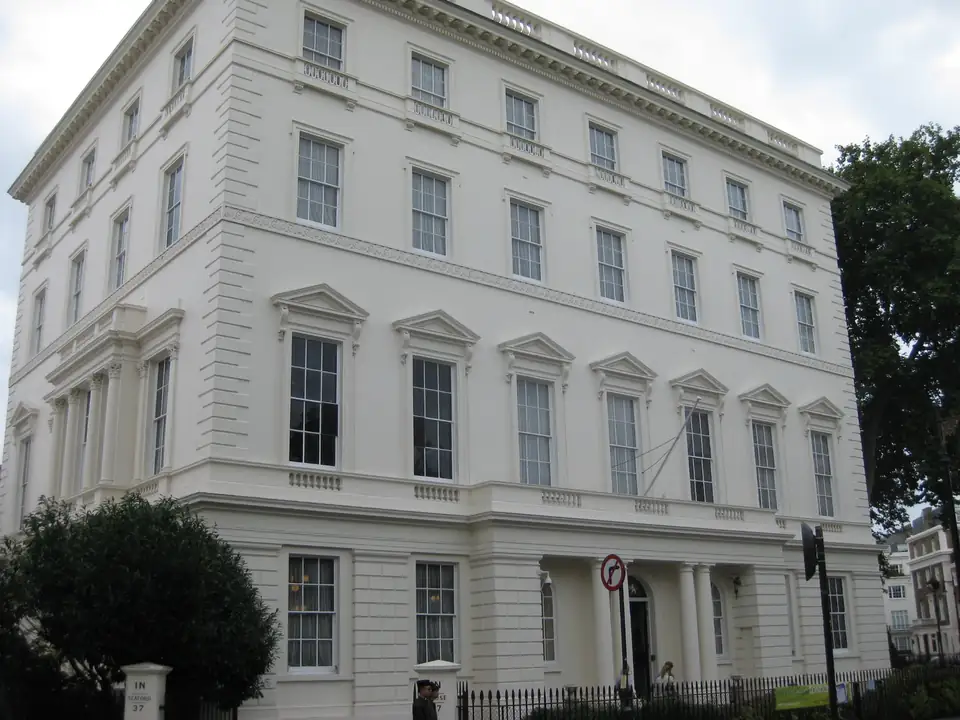
Three things move the work. The first is the grade: a grade II house on a Belgravia square is read against its list entry and its street, while a grade II* house carries interiors of national interest that need room-by-room description. The second is reach: a rear dormer touches one roof slope; a new basement touches the plan form, the lightwells and the front area.
The third is setting. National policy asks for the significance of an asset to be described including any contribution made by its setting, so a garden building beside a listed house, or a roof extension seen across a square, needs the views written up as well as the fabric.
What a statement for a London house contains
A useful statement follows the officer's reading order. It opens with what the building is, drawn from the list entry or the conservation area appraisal; then what is significant about the parts the scheme touches, with photographs; then the effect of each change, element by element, with the design moves that limit it.
It is not a history essay. Councils deal with a heavy load of designated buildings: Westminster alone holds 4,015 list entries and Kensington and Chelsea 39 conservation areas. A statement that answers the significance test in plain order is read faster than one that buries it.
When you need one, and when you do not
Any application affecting a listed building needs one, inside or out, because works to a listed building without consent are a criminal offence under section 9 of the 1990 Act. An unlisted house in a conservation area needs one when the work requires planning permission and changes how the house looks from the street or the backs.
Internal work to an unlisted house, or permitted development that a conservation area does not remove, usually needs no statement. Our heritage statement service starts with a free constraints check that tells you which case you are in before you spend anything.
On its own, or with the drawings
If another designer has drawn your scheme, we write the statement to their sheets for £655. If we draw it, the statement is written with the drawings and checked with them, and our listed building consent drawings from £2,405 include it, along with the measured survey.
The figures, with sources
£0
Council fee for a listed building consent application.
Source: Ribble Valley Borough Council, national fee table from 1 April 2026, checked 17 Oct 2026
£548
Council fee for a householder application to alter or extend one house, from 1 April 2026.
Source: Ribble Valley Borough Council, national fee table from 1 April 2026, checked 17 Oct 2026
HE5
Policy asking applicants to describe the significance of heritage assets affected, setting included, in proportion to their importance.
Source: National Planning Policy Framework, checked 15 Oct 2026
2 years
Maximum prison term on indictment, or a fine, for works to a listed building without consent.
Source: Planning (Listed Buildings and Conservation Areas) Act 1990, section 9, checked 17 Oct 2026
4,015
List entries inside the City of Westminster.
Source: planning.data.gov.uk, listed buildings dataset, checked 17 Oct 2026
1,971
List entries inside the London Borough of Camden.
Source: planning.data.gov.uk, listed buildings dataset, checked 17 Oct 2026
39
Conservation areas published by the Royal Borough of Kensington and Chelsea.
Source: planning.data.gov.uk, conservation areas dataset, checked 7 Oct 2026
21 days
Minimum period a site notice or neighbour letter must run before a planning decision.
Source: Development Management Procedure Order 2015, article 15, checked 15 Oct 2026
Questions
Is a heritage statement the same as a design and access statement?
No. A design and access statement explains the design; a heritage statement explains what is significant about the building and how the works affect it. Some councils accept one document covering both, and ours are written so that either can stand alone.
Can I write my own heritage statement?
You can, and for a small change to an unlisted house some owners do. The risk is a statement that describes the house without answering the significance test, which leads to a request for more information or an invalid application.
Why does the price change from one building to the next?
Statements for grade I or grade II* buildings, or schemes that rework a historic interior, can need archive research and room-by-room recording. For a grade II house or a conservation area extension the work is narrower, which is why ours starts at £655.
Is the fee fixed?
Yes. After the free constraints check we send a fixed fee in writing, with no VAT to add, and any changes the officer asks for are made at no charge until approval.
The fee for heritage statement
What you get
- A reading of the list entry or the conservation area appraisal
- Photographs of the fabric your scheme affects
- Significance and impact, element by element
- A PDF ready to upload with the application
- Any amendments the officer requests, free until approval